Nur Mittel zum Zweck? Die frühen Negative des Volkskundemuseum Wien
Die ersten 1.500 Nummern des Negativinventars – überwiegend Glasplatten – zeigen „das Ländliche“ im Alpen- und Donauraum zwischen 1900 und 1938: Bauernhäuser, Dorfplätze, Trachten und sakrale Objekte. Aufgenommen von Museumsmitarbeiter:innen und regionalen Fachleuten verweisen sie auf die Forschungsschwerpunkte und Bildästhetik ihrer Zeit. Viele Negative entstanden als Reproduktionen von Positivbildern oder als Ausschnitte aus Publikationen. Sie dienten der Herstellung von Abzügen, Dias und Druckabbildungen und galten lange nur als Mittel zum Zweck. Heute jedoch werden sie zunehmend als eigenständige materielle Objekte vor allem in Forschungszusammenhängen geschätzt: Retuschen, Eingriffe, Materialabbau und Spuren der Lagerung treten in farbigen Digitalisaten sichtbar hervor und eröffnen neue Erkenntnisse für verschiedene Disziplinen.
Von Positiven zu Negativen
Erst in den 1930er-Jahren begann das Museum, Negative systematisch zu erfassen – deutlich später als die Positivsammlung, die bereits mit der Museumsgründung in den 1890er-Jahren aufgebaut wurde, und später als die Diasammlung (um 1910) (vgl. die Alben „Right from the start – Die ersten 1.000 Positive der Fotosammlung“ und „Licht aus, Spot an: 1.000 Glasdias und die ersten Lichtbildvorträge des Volkskundemuseum Wien“). Ein Grund dafür war vermutlich die damalige Sichtweise auf dieses Medium: Negative galten nicht als eigenständige Sammlungsobjekte oder „materielle Speicher der Bildinformation“ (Kemp 2015), sondern als reine Gebrauchs- und Indexmittel. Sie dienten lediglich als Mittel zum Zweck zur
1. Herstellung von Papierabzügen,
2. Produktion von Dias für Lichtbildvorträge
3. Reproduktion von Publikationen (neg/657) sowie Positiven (neg/39).
Ein weiterer Grund für den späten Sammlungsbeginn war die zunächst geringe Zahl an Negativen. In den frühen Aufrufen suchte und erhielt das Museum vor allem Positivbilder (vgl. Album „Right from the start – Die ersten 1.000 Positive der Fotosammlung“). Erst mit der zunehmenden Etablierung des Hauses in Bildungsprogrammen und eigenen Publikationen in den 1920er Jahren stieg der Bedarf an Reproduktionen – für Lichtbildvorträge, Druckabbildungen und Abzüge – und damit der Negativbestand (vgl. Album „Licht aus, Spot an: 1.000 Glasdias und die ersten Lichtbildvorträge des Volkskundemuseum Wien“). Hinzu kam die schwierigere Aufbewahrung: Für Glasplatten waren spezielle Holzkästen sowie Pergamin- und Papierhüllen nötig, die sich das chronisch unterfinanzierte Haus erst später leisten konnte. Inventarisiert wurde die Sammlung thematisch; in den Kästen ordnete man die Platten jedoch pragmatisch nach Größe – G für groß, K für klein. Glas- und Nitrozellulose-Negative wurden ohne erkennbares System abwechselnd inventarisiert.
Produktion und Provenienz
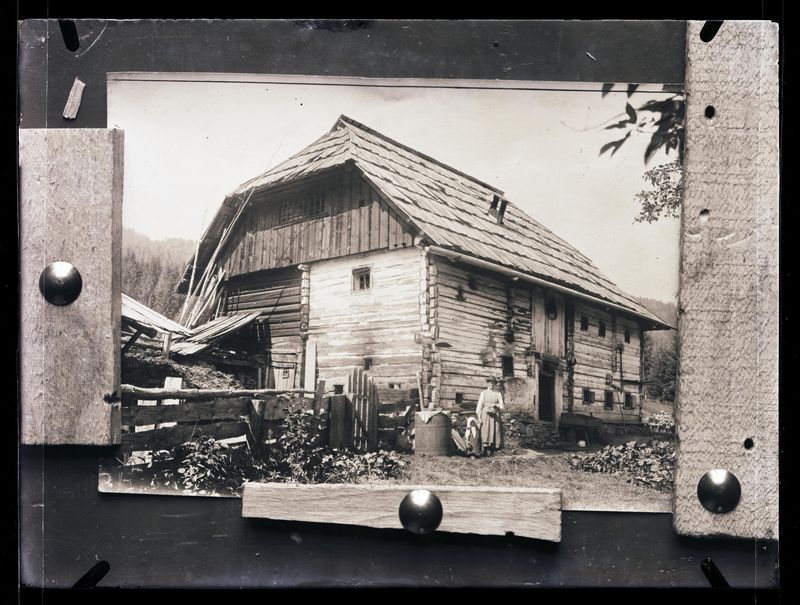
Rund 89 % der Aufnahmen liegen als Schwarz-Weiß-Negative auf Glasplatten vor – damals das gängige Trägermaterial, weil es stabil, lichtunempfindlich und mit hervorragender Bildschärfe war. Die übrigen 11 % wurden auf Nitrozellulosefilm (Celluloid) belichtet, zwar moderner, aber vergänglicher und aufgrund seiner Selbstentzündlichkeit für die Nachwelt ein heikles Medium. Beim Belichten der Platten bzw. des Films schwärzen sich die lichtempfindlichen Silbersalze: Helle Motivpartien werden im Negativ dunkel, dunkle hell. Nach der Entwicklung liefert das Negativ per Kontaktkopie oder Vergrößerung positive Abzüge auf Fotopapier oder Diaplatte (vgl. Album „Licht aus, Spot an: 1.000 Glasdias und die ersten Lichtbildvorträge des Volkskundemuseum Wien“). Vieles deutet auf eine hausinterne Produktion der Negative hin – so etwa die stets gleiche, improvisierte Haltevorrichtung aus Holzleisten, mit der Vorlagen wie Positivabzüge, Buchseiten oder Grafiken für die Reproduktion fixiert wurden (z. B. neg/39). Zur Provenienz fehlen oft Angaben: bei 41 % der Negative ist der/die Fotograf:in unbekannt, weitere 32 % tragen nur den Vermerk „M.f.V.“ (Museum für Volkskunde), Aufnahmeorte fehlen ähnlich häufig (Wien 38 %, unbekannt 21 %). Da viele Bilder reine Reproduktionen (von Positiven) sind, verzichtete man offenbar häufig auf detaillierte Nennungen. Mindestens zwei Drittel der frühen Negative sind wahrscheinlich als Reproduktionen in der Dunkelkammer des Museums entstanden.
Namentlich belegt sind als Fotograf:innen u. a. Arthur Haberlandt (1889–1964), Robert Mucnjak (1901– 1980), Konrad Mautner (1880–1924), Josef König (Lebensdaten unbekannt), Hermine Thirring (Lebensdaten unbekannt), Eugenie Goldstern (1884–1942) und Karl von Spieß (1880–1957). Ihre Aufnahmen stammen vor allem aus der Steiermark, dem Burgenland, Tirol und Salzburg. Einzelne Motive kommen aus Nieder- und Oberösterreich, Kärnten, Vorarlberg, der Slowakei, Frankreich (vor allem Paris) und Ägypten.
Dank der jüngsten Metadatenerfassung aller frühen Fotosammlungsbestände (Negative, Diapositive und Positive) im Digitalisierungsprojekt „Kulturerbe digital“, das vom Bundesministeriums für Kunst, Kultur, öffentlichen Dienst und Sport BMKÖS gefördert wurde, lassen sich lückenhafte Beschreibungen zunehmend ergänzen und neue Einblicke in Entstehung, Provenienz, Nutzung und Wanderwege der Bilder gewinnen.
Was sehen wir?
Die Fotografie hatte sich bis in die 1920er Jahre als dokumentarisches Medium etabliert und wurde auch im musealen Alltag routinemäßiger eingesetzt – für Vorträge und Publikationen. Die Aufnahmen sollten das vermeintlich „Verschwindende“ bewahren (vgl. Album „Right from the start – Die ersten 1.000 Positive der Fotosammlung“). Heute gewähren sie Einblick in die Anfänge wissenschaftlich-ethnologischer Fotografie in Österreich.
Ein Drittel der Sammlung ist Objektfotografie, darunter Heiligenbilder und Votivgaben. Tracht und Personen in Tracht bilden mit 21 % einen weiteren Schwerpunkt, hinzu kommen Bräuche und Feste (11 %) sowie Handwerk und Landwirtschaft (12 %). Die Hausforschung, d. h. Häuser, Architektur sowie Flurdenkmäler wie Marterl und Skulpturen, macht 17 % aus, Ortsansichten und Landschaften 3 %.
Die ersten 1.500 Objekte der Negativsammlung umfassen eine Zeit, die für die Erforschung politisch-ideologischer, soziokultureller und wissenschaftshistorischer Prozesse entscheidend ist. Sie enden mit den beiden Diktaturen auf dem Gebiet des heutigen Österreich: Unter der austrofaschistischen Dollfuß-Schuschnigg-Diktatur (1933–1938) stützten Bilder von „Volkskultur“ und einem „Schönen Österreich“ ein konservativ-totalitäres, „katholisches“ Selbstverständnis, das sich vom NS-Deutschland abgrenzen sollte. Nach 1938 wurden dieselben Motive in den Dienst der nationalsozialistischen Idee einer „rassischen Volksgemeinschaft“ gestellt – auch wenn der hier behandelte Negativbestand 1938 endet.
Manipulation und Inszenierung
Viele Negative verraten aufwändige Vorbereitungen bzw. machen spezielle Fotopraktiken sichtbar: es wurde inszeniert, arrangiert und bearbeitet (neg/448), (Foto-)Objekte wurden auf Unterlagen platziert (neg/669), an Haltevorrichtungen befestigt (neg/39), der Hintergrund mit Tüchern kaschiert bzw. mit Papier maskiert (neg/453) oder mit rotem wasserlöslichem Lack und weichem Bleistift retuschiert (neg/763), äußerer Rand im Positiv in blau-grün sichtbar). Der Einsatz von Rot erklärt sich aus der damaligen Materialität: Orthochromatische Glasplatten waren für Blau und Grün sensibilisiert, sodass Rot auf den Abzügen grau bis schwarz erschien und damit kaum auffiel (Faber 2012). Der damit verbundene handwerkliche Aufwand steht in starkem Kontrast zur heute mühelosen digitalen Bildbearbeitung. Auch deshalb gelten die Negative nicht mehr bloß als Abbilder, sondern als eigenständige, bewusst gestaltete Originale, die Produktionsprozesse und ästhetische Entscheidungen ihrer Zeit spiegeln (vgl. Kulbe 2020).
Vergänglichkeit
Der Zahn der Zeit zeigt sich an den Objekten inzwischen deutlich und erschwert oft die ungehinderte Sicht auf das Motiv: Mal legt sich eine silbrig glänzende Schicht über die Oberfläche – die sogenannte Aussilberung, die durch chemische Zersetzung des Silbers entsteht (z. B. neg/877). Mal vergilbt Schwarz zu Braun oder Gelb. Gelatine löst sich ab, es entstehen Fehlstellen, Brüche und Wellen. Manche Platten verkleben mit der Pergaminhülle, bis das Motiv kaum noch erkennbar ist. Ursache dafür ist der komplex-chemische Aufbau der Fotografien: Organische Bestandteile wie Gelatine und anorganische Schichten aus Glas oder Silber reagieren empfindlich auf Licht, Feuchtigkeit und Temperaturschwankungen und bieten Schimmel ideale Angriffsflächen. Noch kritischer ist die Situation bei der Lagerung von Nitrozellulose-Negativen: entweichen von diesen Salpetergase, so schädigen sie auch benachbarte Glasnegative. Darum sind klimastabile Lagerung und rasche Digitalisierung essenziell, um die Bestände andauernd erhalten zu können. Darüber hinaus erfordert Nitrozellulose durch die leichte Selbstentzündungsgefahr zusätzliche Sicherheitsmaßnahmen.
„Motiv“ vs. „Objekt Negativ“?
Ein Negativ diente ursprünglich nur dazu, ein makelloses Schwarz-Weiß-Positiv zu erzeugen, die Retuschen sollten nicht wahrnehmbar sein, an einen kritischen Alterungsprozess dachte niemand. Heute interessieren uns jedoch Motiv und materielles Objekt gleichermaßen. Ein Schwarz-Weiß-Digitalisat lenkt den Blick auf das Motiv und eignet sich für kultur- und sozialhistorische Analysen. Ein Farbdigitalisat dokumentiert dagegen den Materialzustand – Verfärbungen, Retuschen, Risse, Schimmel – und ist damit unverzichtbar für Restaurator:innen, Archivar:innen und Materialwissenschaftler:innen. Mit dem „material turn“ rückt das Negativ selbst als historisches Zeugnis in den Fokus und offenbart Herstellung, Nutzung und Eingriffe (vgl. Kulbe 2020). So wird das materielle Negativ zum Forschungsobjekt und nicht nur zum Abbild. Idealerweise werden Negativaufnahmen sowohl in Schwarz-Weiß als auch in Farbe digitalisiert, so dass Inhalt und Materialzustand gleichermaßen untersucht werden können sowie wechselseitige Aufschlüsse und zusätzliche Erkenntnisse möglich sind. Für das hier gezeigte Konvolut wurden projektbedingt Farbdigitalisate erstellt, ergänzende Schwarz-Weiß-Versionen sind jedoch in Planung.
Astrid Hammer
Leiterung Fotosammlung
3. Juli 2025
Literatur: